6 min read
What Actually Happens at a Basketball Camp, Start to Finish
A straight look at what actually happens at a youth basketball camp, what to pack, how kids are grouped, and the signs that tell you whether you are paying for coaching or expensive daycare.
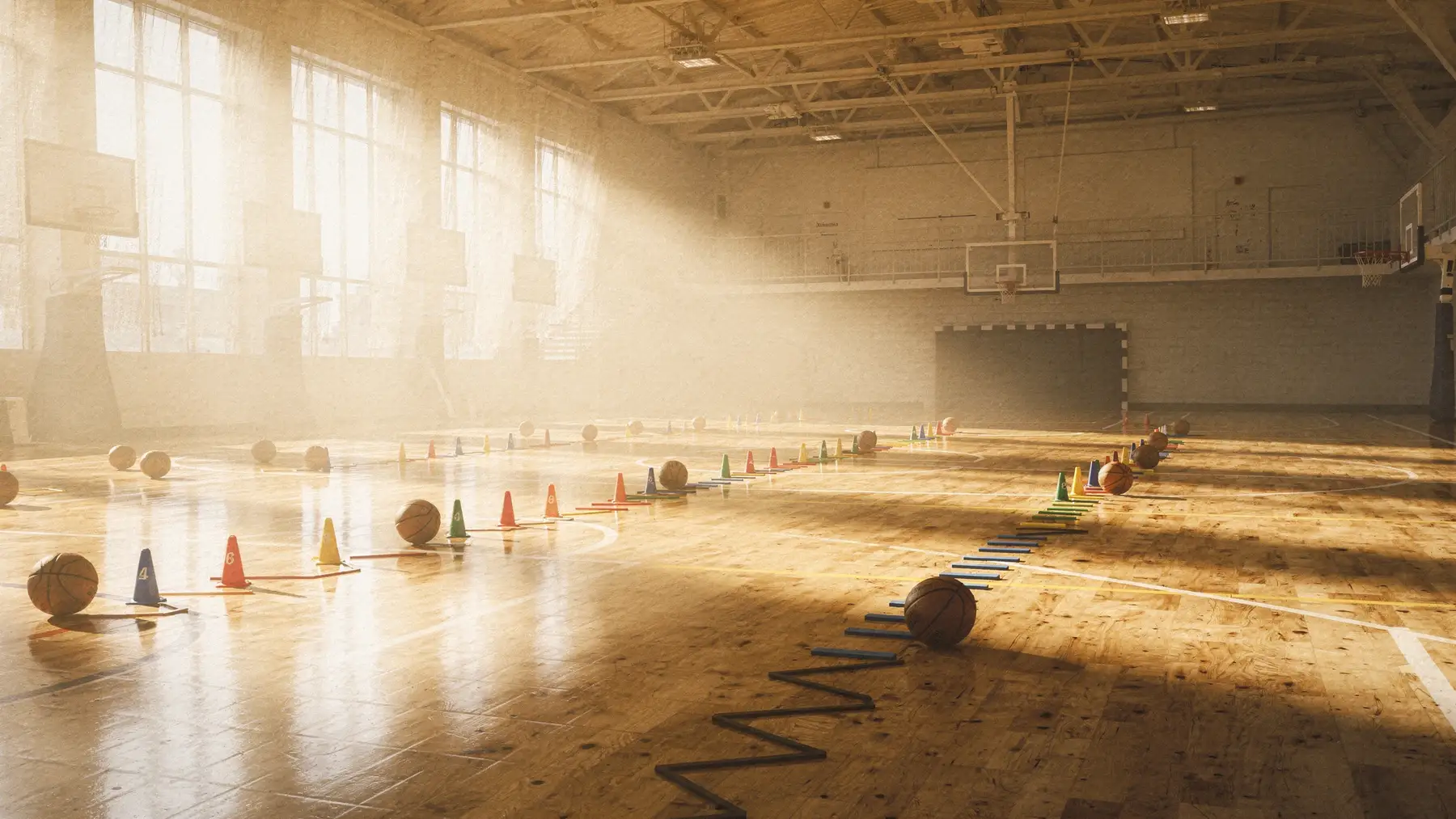
Most parents book a basketball camp with very little idea of what happens between drop-off and pick-up. You hand over a kid with a water bottle in the morning, and at the end of the day you get back someone sweaty who says it was "good" and nothing else.
This is a plain description of what a well-run camp day looks like, what your kid should have in their bag, how groups get sorted, and what separates real coaching from supervised gym time at camp prices. Some camps are worth it. Some are daycare with a basketball in the room. You can usually tell the difference before you pay.
A camp day, start to finish
Our camps are for ages 8 to 14 and run roughly 9:00 AM to 3:00 PM. Times move around on any given day, but a well-structured day has a shape something like this.
- Arrival and free shooting. Kids trickle in, get their shoes on and put up shots. This is not wasted time. Coaches are watching who shoots with two hands, who is nervous, who already knows other kids, and who is standing at the edge of the gym alone. That last one matters most.
- Warm-up and movement. Not laps. Defensive slides, change of direction, jumping and landing on two feet. Kids who land badly get hurt, and this is where that gets corrected.
- Skill block one, usually ball handling and footwork. Kids should have a ball in their hands for most of it. Twenty kids in one line waiting for a layup is a wasted hour.
- Break, washroom, water.
- Skill block two, usually shooting form and finishing. Younger players need closer range and more correction; older ones get more volume and more contact at the rim.
- Lunch, around midday. Kids eat what they brought and sit with their friends. Good camps supervise this properly rather than letting it turn into a free-for-all.
- Games and competitions. Shooting contests, one-on-one, small-sided games. This is where the morning's work either shows up or does not.
- Team play. Small-sided beats full five-on-five for most ages, because everybody touches the ball. Concepts get introduced here: spacing, cutting, when to pass ahead.
- Cool down and a short talk. One idea, not ten. Something a kid can repeat in the car.
- Pick-up at 3:00. Kids should be handed off to a named adult, not released into a parking lot.
How kids get grouped
Grouping shapes your child's week more than the drill list does, and in our experience it is one of the things parents ask about least.
Age alone is the laziest method. An eight-year-old and a fourteen-year-old have different bodies, attention spans and reasons for being there, so some age separation is necessary. But within an age band, kids differ enormously by experience. A twelve-year-old who has played three seasons and a twelve-year-old who picked up a ball in November should not spend the whole day in the same drill.
What good camps do is group loosely by age first, then adjust by ability during the first morning, once coaches have watched everyone move. Groups should stay flexible all week. A kid who is drowning gets moved. A kid who is bored gets moved. Nobody is publicly ranked or made an example of.
Ask how many kids are in a group and how many coaches are with them. A coach who knows names beats a big gym with one loud voice.
What your kid should bring
Keep it simple. Overpacking causes more lost items than it prevents.
- Indoor court shoes that fit properly, not skate shoes and not last year's pair a size too small. Bad shoes roll ankles.
- A large refillable water bottle with their name on it. One small bottle will not last a full day.
- A packed lunch plus two snacks. Kids burn through more than parents expect, and the mid-afternoon collapse is usually a food problem.
- A second shirt. Day one they will not think they need it. Day two they will.
- Any inhaler, EpiPen or medication, clearly labelled and handed to a coach in person at drop-off rather than left in a backpack.
- Athletic tape or a brace if they already use one.
- Their name on everything. Everything.
Leave at home: valuables, phones they cannot afford to lose, and a new ball they will be upset about losing. Ask whether balls are supplied. Ours are.
How to tell a good camp from expensive daycare
Walk in during a session, or ask for detail before you register, and look for these things.
Kids are moving and touching a ball. Long lines waiting for a turn mean the drill was built for the coach's convenience, not the players' development.
Coaches are correcting individuals by name. You should hear specific instructions to specific kids, not only general encouragement.
There is a written plan. A camp that can tell you what Tuesday looks like has thought about Tuesday. Coaches build those plans in all sorts of ways, and if you coach a school or rec team yourself, Six Seven Ball is basketball coaching software with a drill library, a play designer and practice planning tools, and it is worth a look. We do not own it and have no connection to it. The point stands either way: a camp running off a real plan looks different from one improvising each morning.
The day has variety and a rhythm. A full day of nothing but drills breaks kids down. A full day of nothing but scrimmaging teaches little. Good camps alternate.
Beginners are not humiliated. Watch how the least skilled kid in the gym is treated. That tells you more than any brochure.
Your kid can tell you one thing they learned. Ask on day two: "What did a coach tell you to fix?" A specific answer, even a small one, is a good sign. "We just played" all week is not.
Questions worth asking before you pay
How many kids per group, and how many coaches with them. How are groups decided, and can they change. What is the refund policy if my kid is sick. Who supervises lunch. What happens if my child gets hurt, and who calls me. Any camp worth your money answers these quickly and without irritation.
What our camps cost
Chatham Kings camps are for ages 8 to 14, running roughly 9:00 AM to 3:00 PM. Early bird registration is $225 and regular registration is $249. Details are on the camps page.
If cost is the obstacle, say so. We hold scholarship spots, funded by sponsors and community support, and enquiries are handled privately. Programs such as Jumpstart and KidSport are also worth asking about.
We have not announced dates. If you are searching for a basketball camp in Chatham-Kent right now, the honest answer is that nothing is confirmed on our end, and we will not list a date we cannot hold. When dates are set, they go on the site. In the meantime, the Chatham-Kent Wildcats and the school programs around Chatham, Wallaceburg, Blenheim, Tilbury, Ridgetown and Dresden are worth looking into. We want kids playing, including in programs that are not ours.
We also will not tell you that a week of camp changes a career. It does not. A good camp gives a kid some visible improvement, a better relationship with the gym, and friends they will see again. That is a fair return for the money. Anything beyond that comes from what they do in the months afterwards, which is what our year-round training and small-group sessions are for.
If we have not answered your question here, ask us directly through the contact page. We would rather talk you out of the wrong program than take a registration that does not fit your kid.